Archive for the ‘Raw feeding’ Category

h1

Raw feeding recipe using Woldsway Rabbit

9 July, 2008

Raw Rabbit Recipe

INGREDIENTS

1 x 0.5kg pack of boneless wild rabbit chunks

1 x 0.5kg pack of mixed rabbit offal (heart, liver, kidney, lungs)

1 x 0.5kg pack of minced wild rabbit (bone-in – VERY IMPORTANT for the calcium content)

2 x raw egg yolks (preferably organic or free-range)

2000mg taurine (very important if using frozen meat, or will be freezing the meat)

400IU Vitamin E

100mg Vitamin B

2000mg salmon oil

1 tsp kelp

1 tsp psyllium husk

Preparation

Cut rabbit chunks into smaller chunks if feeding kittens.  Puree offal in meat grinder.  Mix with mince.  Place in large bowl.  Add approx. 200-300ml of water.  Add egg yolks (not the egg whites).  Open supplement capsules and sprinkle over mix.  Mix with spoon or if feeling bloodthirsy, hands.  Spoon mix into small freezer bags.  Approx. 3 dessertspoons per bag will feed 5 kittens (at 7 weeks’ old) per meal.  Will make approx. 10 bags x 3 spoons per bag.  This is approx. 3 days’ worth of food.

Rabbit from http://www.woldsway.co.uk/acatalog/Pet_Meat.html

Supplements from various sources (mostly dry, powder version for ease of mixing)

h1

Kittens 2008 – their first meal

25 June, 2008

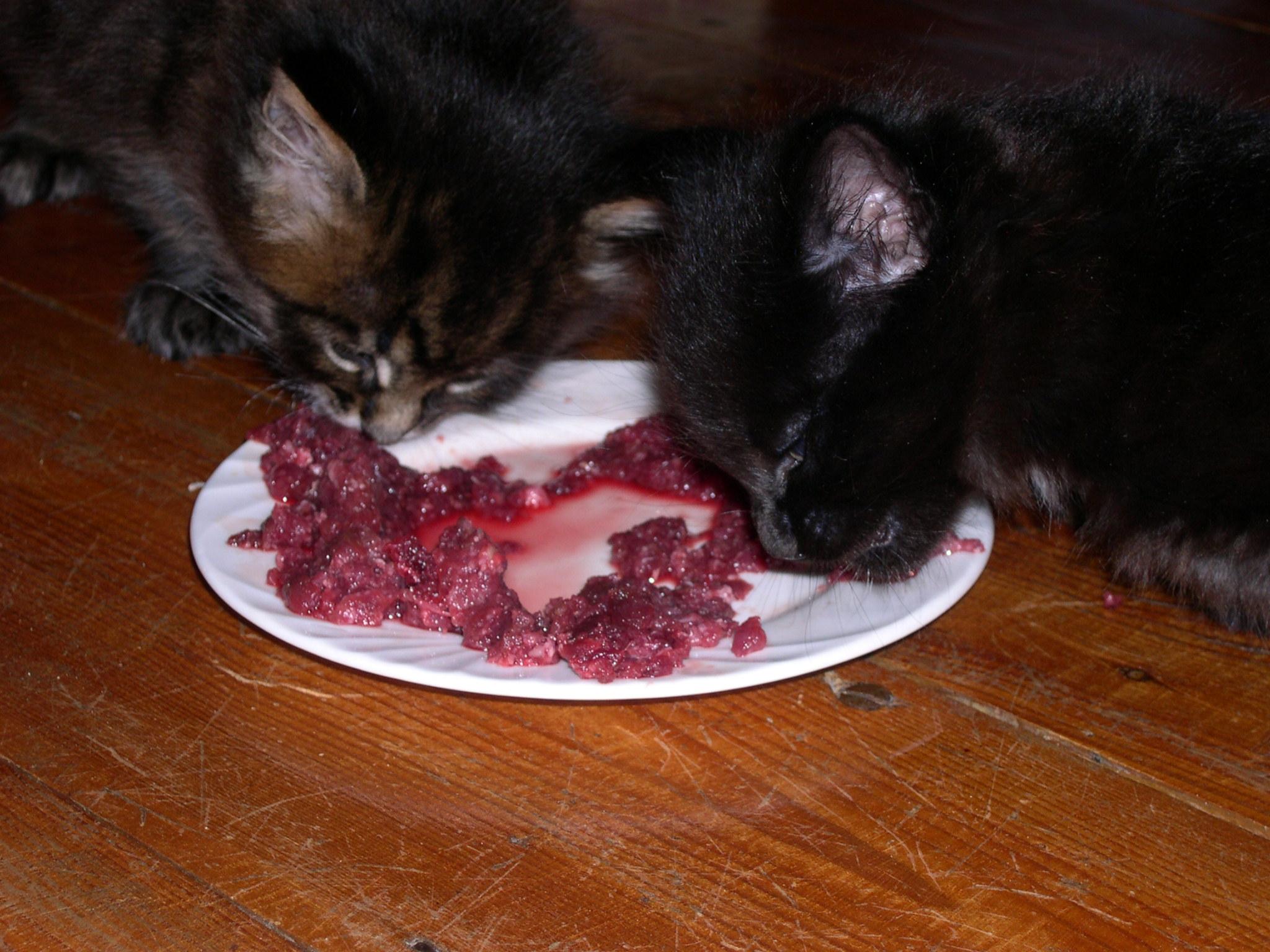
Here is a photo of the first meal I gave the kittens.  As mentioned in my previous post, even though the kittens were just 4 weeks’ old, Mum Cat kept bringing them chicks to eat.  Of course they were too small to even attempt to eat them, but I felt they might be old enough to attempt solids.

I wean kittens onto raw meat.  In this photo, they are tucking into wild rabbit mince gound with the bone, mixed with pureed offal (lungs, heart and liver) and little kitten-mouth-sized chunks of rabbit.  I got it all from Woldsway Rabbit who this year have started doing offal packs – many thanks!  Into this mix I add egg yolks, taurine, Vitamin E, Vitamin B-complex, kelp and psyllium husk.

It is a labour of love – it is more time-consuming to have to put together a home-prepared diet rather than just open a bag of cat biscuits and pour into a bowl.  From reading other breeders’ experiences, I do believe that kittens take more readily to raw food.  Certainly, as you can see from the photo they seem to recognise what food is. 

Not all the kittens ate the raw meat in that first encounter.  In the photo are Mum Cat who’s setting them an example – she frequently calls them to their food – the two boy kittens and one of the creams.  I don’t try to force the kittens to wean if they’re not ready.  All of them are still suckling from Mum.  And the littlest cream kitten isn’t eating as much raw.  However, to date all the kittens are now eating some raw.

h1

Raw feeding – UK sources for meat and supplements

28 August, 2007

Many raw-feeding web-sites are of US origin, with suppliers based in the US.  Here is a list of UK suppliers and stockists of raw pet meat and supplements:

MEAT GRINDER

There are many meat grinders on the market, but not all of them are equal! And don’t even consider a hand-driven meat grinder unless you are an arm wrestler! There is only one meat grinder I use – it’s the one that’s also recommended by many raw-feeding forums. About £85 (excluding delivery). There are cheaper brands on the market, but they can’t grind bone. This workhorse is made from aluminium and will last.

Electric Meat Grinder from Northern Tools (Item No.: 168620E)

http://www.northerntooluk.com/products.asp?partno=168620

MEAT

Rabbit meat

I’m currently using the pet mince made from wild rabbit from Woldsway Rabbit. It’s ground with the bone-in for that important calcium content. It’s a richer red than the farmed rabbit mince. However, the quality of all Woldsway rabbit is always good. But go for the wild rabbit mince – your cat will thank you. I buy the mince and the farmed rabbit chunks, thaw slightly then mix with supplements and offal, and refreeze.

Woldsway Rabbit – http://www.woldsway.co.uk/

0800 298 5000. The meat is delivered frozen with ice packs.

General pet meat

Graig Farm Organics. http://www.graigfarm.co.uk/catalog/cat_11.htm

This is an award-winning organic-meat company. The pet mince is mainly from offcuts and offal and is of human quality. The mince is a dark paste, you cut a corner off the packet and squeeze it out. The meat is delivered frozen. They also sell chicken heart and liver.

Yeoman’s Meat Company: 01773712226. I’ve never used this company as they’re based in Nottingham and don’t deliver this far South. Some breeders have used them and like the quality. They do ox cheek, rabbit and general pet mince.  [please see one of the comments left below - Yeoman's has been taken over by http://www.back-2-nature.co.uk - I haven't tried their products yet as I haven't see it being sold in the London area]

Prize Choice from Anglian Meat Products: http://www.prizechoice.co.uk/.

Set up by some vets who were interested in bones and raw food (BARF). Some of their meat has the bone ground in. I haven’t really tried their meat. You will find them in large pet stores.

Chicken

You can get this from any supermarket or poultry butcher. My favourite butcher is in a farmer’s market. I trust the quality of his free-range chickens, and he gives me free giblets because of the amount of chicken I buy.  Please try to use free-range chickens because they don’t stand all day in their shit and therefore the risk of contamination from salmonella is lower.

Lamb/Beef: look in your supermarket and buy casserole chunks. Don’t buy the mince because (1) you don’t know how long it’s been sitting on the shelves (2) mince gets contaminated more easily with bacteria because of there is more surface area with mince. Don’t feed pork to cats – it can contain a parasite that is fatal to cats.

Offal

Often, many raw-feeding recipes call for offal to be added, namely chicken heart and liver. Now, chicken liver you can get from any supermarket or poultry butcher. However, the only places I’ve been able to source fresh chicken heart are ethnic butchers or Chinese supermarkets. As for kidney, try a supermarket or a butcher. If you make friends with your local butcher he may give you giblets (i.e. a pack made up of a chicken neck, liver and heart) for free.

Whole prey

You may like to give your little tiger a taste of a small chick or mouse. Livefoods supplies frozen food for people who keep reptiles as pets. Postage can be quite expensive as they use a courier. I usually order in bulk – if I order 400 chicks, then even with postage, it works out to about 4p a chick.

SUPPLEMENTS

If you have friends or family visiting the US, beg them to buy vitamins and supplements and bring them back for you. Fact: Supplements are cheaper in the US: you’ll pay $ for what they charge £s for in this country. And you can’t get certain supplements, like glandulars (extracts from glands) in the UK due to EU regulations.

If you want supplements that are pre-mixed, then either Feline Future or Feline Instincts from the US are your only sources. These supplements often come with dried egg yolk in them. Note: not only will you have to pay shipping (i.e. postage costs), but also import Tax when it comes into the UK – anything over £18 is charged tax plus VAT. The costs can be prohibitive.

It might be more cost-effective to get each individual supplement itself. The supplements you will need to get are: Taurine, Vitamin A, Vitamin B complex, Vitamin E, kelp and dulse powder, fish oil capsules. I use Google to try to find the discounts. However, some of the sites I have used are:

Nutrisun for Taurine (Solgar) 500mg capsules, Vitamin A (Solgar) capsules, Vitamin B Complex (Solgar) capsules, Vitamin E (Solgar) 268mg capsules. Be careful when you buy Vitamin B – often manufacturers add herbs like alfalfa which they claim is synergistic in action. Maybe that’s so for humans, but not for cats.

Hellenia Health Foods has a Vet’s Choice section with good value kelp powder.

Another online source of supplements is Nutricentre.

Psyllium husk – this is usually ridiculously expensive, and sold in teeny packets, I’m not sure why. However, the best value so far is a brand called Maxicol. It comes in a large tin which contains psyllium husks together with pre-biotics and digestive bacteria.

I have not been able to find a source of reasonably-priced dulse powder in the UK.

h1

Kittens – raw feeding – importance of fibre

22 July, 2007

This follows on from my post on the kitten with the sticky bum.

Turns out the pumpkin did the trick and Roly produced a beautiful one.  It was firm, solid and everything that sites on raw feeding claim raw-fed cat poo should be.

Unfortunately, he did it on the front door mat.  But hey, at least he didn’t wipe his bum clean on the carpet.

The thing is, I almost didn’t find it either because it was relatively smell-less.  A lack of smell is not something you normally associate cat poo with, but it’s true with raw fed cats/kittens.  It’s something that was mentioned in the Winn Feline Foundation Report on diet and cats too.

Fibre is something that raw feeders may or may not have to add to the raw food.  It helps to ease the passage of food along the bowels.  Some cats don’t need additional fibre.  Some do.  It all depends on the cat.

If you think about one of the natural food sources of a cat in the wild, it’s a mouse, which would have a stomach full of digested grain (or  bird, with its fibrous feathers).  That would be a source of fibre for the cat.  How to duplicate this source of fibre for our domesticated cats?

I used pumpkin in this instance with Roly.  Some experts advocate adding psyllium husk instead, but some (e.g. rawpaws) don’t.  It’s something you’ll want to investigate and try out for yourself.

h1

Mr. Sticky Bum

19 July, 2007

Good news: Roly (the male tabby kitten) has finally got the hang of using the litter tray for the Big Ones.

Bad news: Roly’s poo is still sticking to his bum and to get it off he drags his bum on the floor. This morning was a frenzy of cleaning as the floor was smeared. I had a look at his offering in the litter tray, and it was quite well-formed, so I’m not sure why it’s sticking to his bum.

Bad news: Roly’s not cleaning his bum properly, and mum hasn’t bothered either. So I had to do it. Yum – just what I needed before breakfast.

So I’m off to find some pureed pumpkin which is supposed to be very good at firming up the poo. I think maybe the raw food I’m giving the kittens needs some fibre in it.  In the meantime, Roly has a new nickname: Mr. Sticky Bum.

h1

Kittens – weaning through raw feeding – importance of Taurine

16 July, 2007

Kittens eating minced rabbit

kittenseating1

Here’s a photo of the kittens at one of their first meals of wild minced rabbit (whole, with no tripe, bone-in).

It’s said that weaning kittens is relatively easy using a raw diet.  I can only speak from personal experience and say that seems to be the case: the kittens seem to recognise what natural food is.

I know some sites on kitten weaning mention offering first meals of rice/rice pudding/milk/porridge.  If those work, great!  However, I don’t think rice/porridge are what cats would eat in the wild.  And cats lack the enzymes to digest cow’s milk.

The first meal the kittens had was freshly-minced whole chicken with bone-in.  The recipe was the same as the adult recipe, except that the chunks of chicken were cut into smaller, kitten-sized pieces.  I also made sure that each chunk wasn’t joined to any other chunk.  Last year, a kitten nearly choked when she swalloed a chunk which was joined to another by a tendon – she couldn’t chew on the second chunk and it stuck in her throat until I managed to hoick it out with a finger.

I tried them on lamb as well, but they didn’t like the mince as much as just chunks.  And Poly, the black girl kitten prefers lamb to the chicken.  When I feed lamb chunks I am careful to add some calcium supplement (Stress) to it because the lamb chunks don’t have minced bone to provide calcium.   This is very important.  When you look for suppliers of pet mince, make sure that it’s been minced with the bone-in.

Last year, I got my wild rabbit whole from my sister-in-law and her husband who have a smallholding which is overrun by rabbits.

This year, I discovered that Woldsway Rabbit have started offering wild rabbit in their pet food range.  They already do a range with farmed rabbit, but my cats prefer wild rabbit.  It’s got a richer look to it too.  I’m usually cautious about using commercially-made raw pet food, but David Blythe of Woldsway assures me that he’s had to implement EU standards of food preparation that are usually used in human-food preparation.

The rabbit comes frozen in packs of 0.5kg.  It’s a little on the large size to thaw out completely, so what I do is let it defrost slightly so I can break the pack up into smaller meal-sized portions which I then defrost totally.

One caveat is that you should always vary your cat’s diet, so that it does not consist exclusively of one type of meat.

And if you do feed a frozen-type raw meat diet, you must supplement with taurine.

Taurine is an amino acid which helps cats digest fats.  Unlike other species of animals, cats cannot use another amino acid for this function.  Taurine is essential in healthy heart-functioning for cats.

A Winn Feline Foundation Report on diet and cats showed that feeding only ground rabbit led to a Taurine deficiency.  This was possibly due to the fact that when meat is frozen, it loses taurine and Vitamin E.

So always supplement raw diets with taurine. You can buy powdered taurine in capsules.  Solgar is one such brand.  Michelle Bernard of blakkatz.com recommends adding at least 2000mg of taurine for every 2.5 pounds of meat.

h1

Raw feeding for Kittens (again)

11 July, 2007

Well, after last year’s success I was shining my fingernails on my shirt, thinking I’d had the weaning problem solved.  Of course Hubris meant that I would be writing this, humbled and confused.

I’d taken Monday off work to prepare raw mince for the kittens.

I made two batches of raw mince – one was lamb and the other was chicken.

Last year, the litter of seven had taken to the mince chicken like it was mother’s milk.

Anyway, the chicken recipe was close to the one set out in Michelle Bernard’s Blakkatz.com site.  And the lamb one was a variant, using lamb chunks which I minced together with a lamb heart and lamb kidneys.   The chicken was free-range, from Springfield Farm in Hertfordshire, bought from my favourite poulterers in Borough Market [I did say my cats get the best].  They’re my favourite because I get extra giblets, and they save rabbit heads for me.

I put a plate of freshly-prepared chicken mince down, and to my surprise (but actually, not really), both kittens tucked in.  It was that natural.  The boy actually took to it more readily than the girl, not sure why.  The girl took a few licks, then backed away, as though it was something she wasn’t quite sure of.

The second day I put some lamb mince down.  They weren’t having any of it.

So I put some more chicken mince down.  But it had been frozen, and they didn’t touch it.

Today I chopped some lamb into leetle chunks and put it down.  They whalloped it.

So I’m confused now.  Chicken mince yes, then no.  Lamb mince no.  What was putting them off the lamb mince?  Was it the supplements I’d added?  I’d added the same to the chicken mince.  Was it because it wasn’t fresh but frozen? (lord, please, not gourmet kittens).

I have one more weapon in my armoury. Minced wild rabbit.  Woldsway rabbit are now selling pet mince made with wild rabbit.  Last year I got some from one of my sister-in-law’s who together with her husband was farming a small-holding in Norfolk which was overrun by rabbits.  The kittens loved the wild rabbit, and so did Teddy.

So I was glad that Woldsway have started offering a wild rabbit alternative.  Wild rabbit is just that more richer in taste and colour than farmed rabbit.

I’m hoping it will reach the bits of the kittens that domestic chicken and lamb can’t.

More soon.

h1

Raw Feeding guru: Michelle Bernard of blakkatz.com

5 October, 2006

I have been warbling on in the past few months about the benefits of raw-feeding for cats, and probably gave you the impression that I know it all.

Not at all.

Most of my knowledge has come mainly from the leading authority on raw-feeding for cats: Michelle Bernard of the Blakkatz cattery in the USA.

Whenever anyone writes to me asking for advice, I point them to her web-site: www.blakkatz.com.

She’s made it easy for people who are interested in raw-feeding – she’s done all the research into cat nutrition, she’s worked on raw-feeding recipes and more importantly she walks the talk where holistic rearing is concerned: Her cats are 100% raw-fed and she uses homeopathy to correct health imbalances.

And if you’ve been looking for a book on raw-feeding for cats, she’s written the only one that is backed up by scientific research and years of experience. It’s called: “Raising Cats Naturally: How to care for your cat the way nature intended”.

There are other books on raw feeding, but not one specifically for cats – that’s an important distinction because some raw-feeding books may have recipes for dogs which have different nutritional requirements to cats. Her book also has a clear explanation on how to use homeopathy for cats.

She’s been the source of encouragement and inspiration for people like me looking for a safer and healthier way to raise their pets.

And oh … she writes a great blog too … you’ll love reading about her cats, the litter of kittens she’s recently rescued, and her wonder dog, Angelus, a Border Collie!

h1

You know you’re a Cat Breeder (3) when …

31 August, 2006

 RawFeeding1

You know you’re a cat breeder when you buy a chicken costing £6.93 for the cats and then agonise over splurging out £4.95 for a Marks & Spencer’s shepherds pie for yours and hubby’s dinner.

Doubtless, said chicken was a happy free-range chicken. But still. Feeding raw costs a fortune especially when you’re feeding 3 adult cats and 7 ravenous kittens. They are going through about 5 chickens a week. I leave you to work out my food bill (sans hubby’s feed).

I don’t know … maybe I’ll have to switch to commercial because I could be spending time with the kittens rather than sweating over a meat grinder. I can understand why cat breeders feed commercial – it’s just so much more economical and convenient: just open the box/tin/packet … and pour.

And surely commercial can’t be that bad … I do wonder sometimes when I see Grand Champions in the show ring, with luxuriant coats and huge boning, the result of years of Royal Canin Maine Coon.

But I’ve seen the results of raw feeding in my queen, Ananda – she fully-converted to raw about 3 weeks ago and her coat is amazing – her tail is bushier and her energy levels have gone up. This is a queen who’s still nursing. A breeder I know in the US says her queens never lose condition during or after pregnancy because she feeds raw.

I don’t know. It’s 9pm now on a Thursday evening and I’ve got 1.5 hours of chunking and grinding a chicken because if I don’t they won’t have any food tomorrow. Ah … the joys of raw feeding!

Thank goodness hubby likes M&S Shepherds Pie (and Cumberland Pie and anything with mash, actually).

h1

Diet: Good news – Mum Cat goes raw

20 August, 2006

For the past two years I’ve been trying to get my Maine Coon girl to eat a raw diet.

In case you’re curious, the raw diet I feed my cats is home-prepared. Usually I chunk free-range chicken meat, then grind up the rest of the chicken (bones-and-all) and add egg yolks and supplements to the ground-up mix. If you want more information on the recipe, check out www.blakkatz.com or www.feline-future.com. I believe it’s a diet that’s closer to what cats eat in the wild. The benefits are increased levels of energy, better health and condition and less smelly poo.

Because my Bengal was brought up eating some raw food, it was easy to transition her to a raw diet. My Maine Coon girl, however, preferred commercial cat food because (I suspect) it has stronger flavours and smells. Because she refused to eat anything but commercial, I experimented with different types of cat food. Whenever I tried to (cunningly I thought) hide bits of chicken mix in her commercial food, she would eat round it and give me a look of scorn that I had dared to dupe her.

After two years, I resigned myself to letting her have what she wanted – whatever it took to keep her happy. Her condition was good, and hey – she had had a litter of seven healthy kittens, didn’t she?

Last weekend she surprised me totally by eating the chicken mix. I think what happened was that I had been feeding the kittens chicken mix and she probably started clearing their plate up when they couldn’t finish their food, and developed a taste for it.

The first sign I had that she was eating raw was that her appetite increased. This was a good sign because most mother cats lose weight when they feed their kittens, and my Mum Cat had been picky with her food too.

She woke me up last Saturday night crying for food. I went into the kitchen and put some food down for the kittens, and she ate that. So I put more down and she ate that too. It was as if her body was craving something that she was finally getting with the raw food. I couldn’t believe my eyes and just kept feeding her.

She only woke me up four times that Saturday night at two-hour intervals, but I didn’t mind. I noticed this week that her tail fur is thicker and fuller and that she doesn’t seem to be as tired as she used to be when feeding the kittens.